Pitstop Joins the Fullbay Family
We’ve got some exciting news to report: Pitstop is joining the Fullbay family.
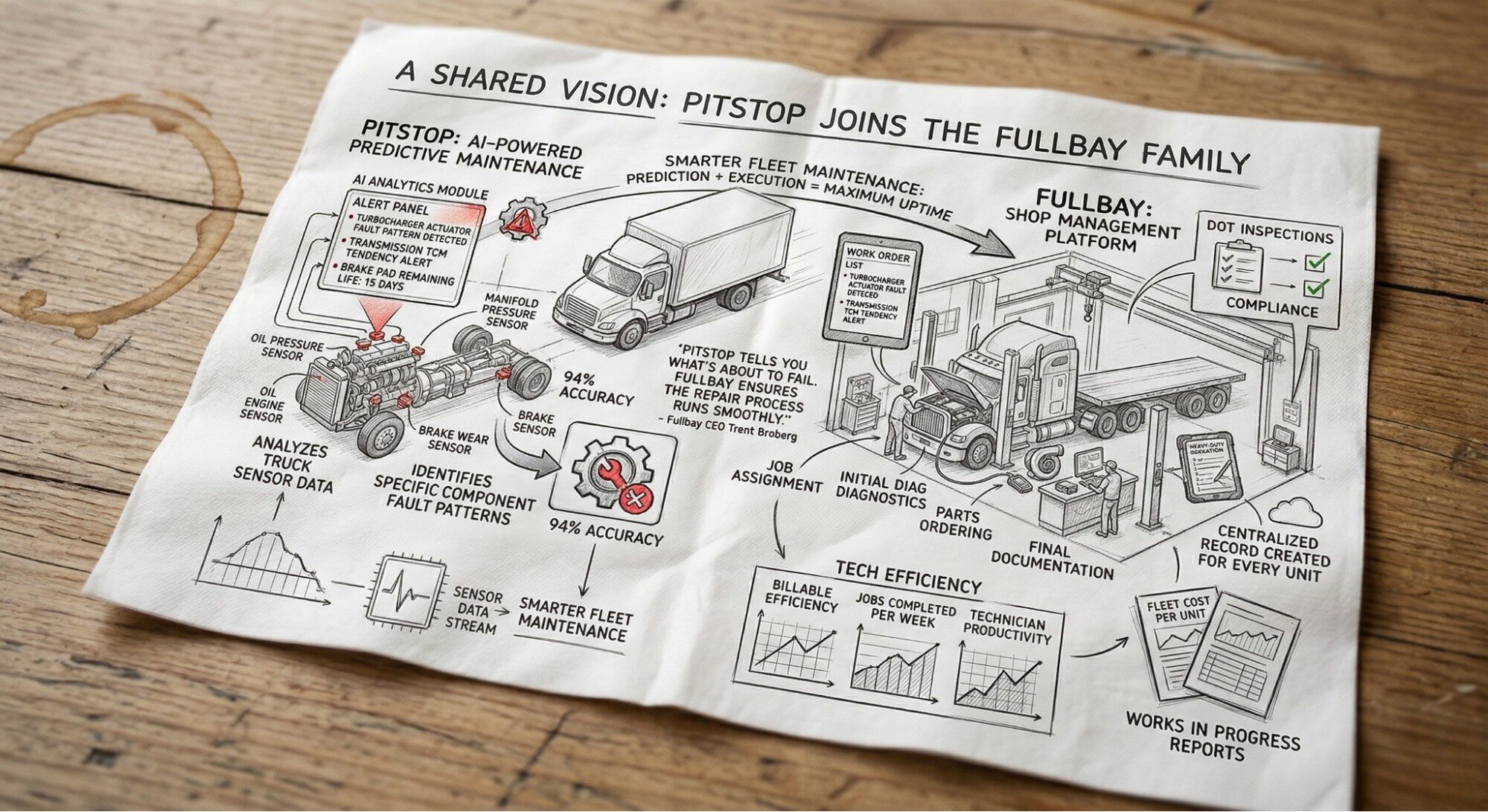
Pitstop is a recognized pioneer in AI-powered predictive maintenance, analyzing billions of data points to detect fault patterns and identify issues weeks before a breakdown occurs. With more than 94% accuracy in identifying potential failures, Pitstop enables large fleets to fundamentally shift from reactive service to proactive maintenance planning.
Furthermore, Pitstop powers the entire fleet maintenance workflow. It enables fleets to triage vehicles based on faults, predictions, preventive maintenance schedules, inspections/DVIRs, then automatically trigger the necessary maintenance workflow. Once repairs are completed, Pitstop’s AI invoice scan, the first of its kind in fleet, automatically captures and processes repair documentation, eliminating the manual data entry that often bogs down fleet managers.
For fleets, the biggest enemy is downtime. And downtime really comes down to two things: the breakdown and dwell time. Pitstop helps the fleet address the breakdown which is the first half of the equation. The next step is the most critical: getting the repair completed and crushing dwell time.
That’s where Fullbay comes in.
In 2014, one of Fullbay’s co-founders was working in a heavy-duty shop and saw firsthand how many operations still ran on whiteboards and scribbled, often indecipherable notes. The industry simply didn’t have software built specifically for how heavy-duty shops actually work.
Fullbay was created to change that. Over the last decade, it has grown into the largest and most trusted shop management platform in heavy-duty repair, helping more than 5,000 shops manage millions of service orders and run more organized and efficient operations. At its core, Fullbay focuses on what happens inside the shop: the people, the processes, and the workflows that turn maintenance plans into completed repairs.
That’s where the alignment between Fullbay and Pitstop becomes clear. Both platforms are built around the same idea: maintenance works best when it’s planned instead of reactive. As Fullbay CEO Trent Broberg puts it, “Pitstop tells you what’s about to fail. Fullbay ensures the repair process runs smoothly when it’s time to fix it.”
DOCUMENTATION STREAMLINES COMPLIANCE
Every step of the repair workflow is completed inside Fullbay. That includes job assignment, initial diag work, the ordering of any required parts, and final documentation. The workflow doesn’t just keep repairs moving; it also creates a complete, centralized record for every unit. At any point, techs can pull up a vehicle’s history and see past repairs, recurring issues, and upcoming preventive maintenance needs.
All that documentation is extremely useful when it comes to inspections and compliance. Instead of tracking down paperwork or piecing together records from multiple systems, shops have a clear, organized history of the work that’s been performed. Fullbay also supports digital inspection workflows, including DOT inspections, so a fleet can document results as part of its normal process instead of treating compliance as a separate task.
Clear, consistent records for every job mean fleets can more easily stay organized and meet regulatory requirements.
Enabling Fleets to book realtime with the Fullbay shop network is a massive value unlock
Repair operations depend on their technicians, but when the shop gets busy, figuring out who is working on what — and how efficiently that work is getting done — can get challenging. Fullbay tracks metrics like billable efficiency, jobs completed per week, and technician productivity, which calculates hours worked compared to total hours clocked in. With that information in hand, managers can quickly see how much work is flowing through the shop and where time is being spent.
These metrics can also explain performance. If one technician is completing fewer jobs than the rest of the team, the data can help uncover why. It may be a training opportunity, but it could also point to factors like parts delays or assignment bottlenecks.
By making technician activity more transparent, Fullbay helps crews identify where adjustments can be made, whether that’s improving processes or removing obstacles. And for internal fleet operations, that efficiency has a direct financial impact — when techs spend more time on productive work and less time waiting on jobs, maintenance and repairs become more predictable. That leads to decreased downtime and costs that are easier to control. Over time, that productivity shift can transform a shop from a cost center to a profit center.
POWERFUL REPORTING FEATURES
Fullbay’s reports can pull back the curtain on a fleet’s inner workings, giving managers a clearer picture of where time, money, and resources are actually going. Instead of relying on gut feeling or scattered data (or worse, Post-Its), they can make decisions based on what’s really happening in the shop day to day.
Some of the capabilities that will appeal to fleets include:
- How quickly (or slowly) parts are moving.
- Fleet cost per unit (and its companion, the overall fleet report).
- Works in progress reports — what vehicles are in the bay and how they’re coming along.
That kind of visibility makes it easier to spot inefficiencies early, whether it’s parts delays, jobs that are taking longer than expected, or units costing more to maintain than they should. It also helps fleets answer bigger-picture questions: Are we allocating resources properly? Are any assets becoming liabilities? Where can we improve turnaround time?
Fullbay offers a wide range of reports, each designed to give shops a better understanding of their performance. With the right data in hand, fleet managers can move from reacting to problems to actually improving how their operation runs.
A SHARED VISION FOR SMARTER FLEET MAINTENANCE
Every fleet wants to eliminate downtime while Every shop wants to fill their bays while performing effecient service. Thats why Pitstop & Fullbay are going to be better together. Pitstop delivers uptime through predictive fleet management tied right into Fullbay which attacks repair time by giving shops the tools to move work through the bay faster, structured workflows, real-time tech assignment, parts tracking, and documentation that’s done before the truck leaves.
Fullbay will work alongside Pitstop today as a complementary solution, with integration on the way. More details are coming — we’ll keep you updated!